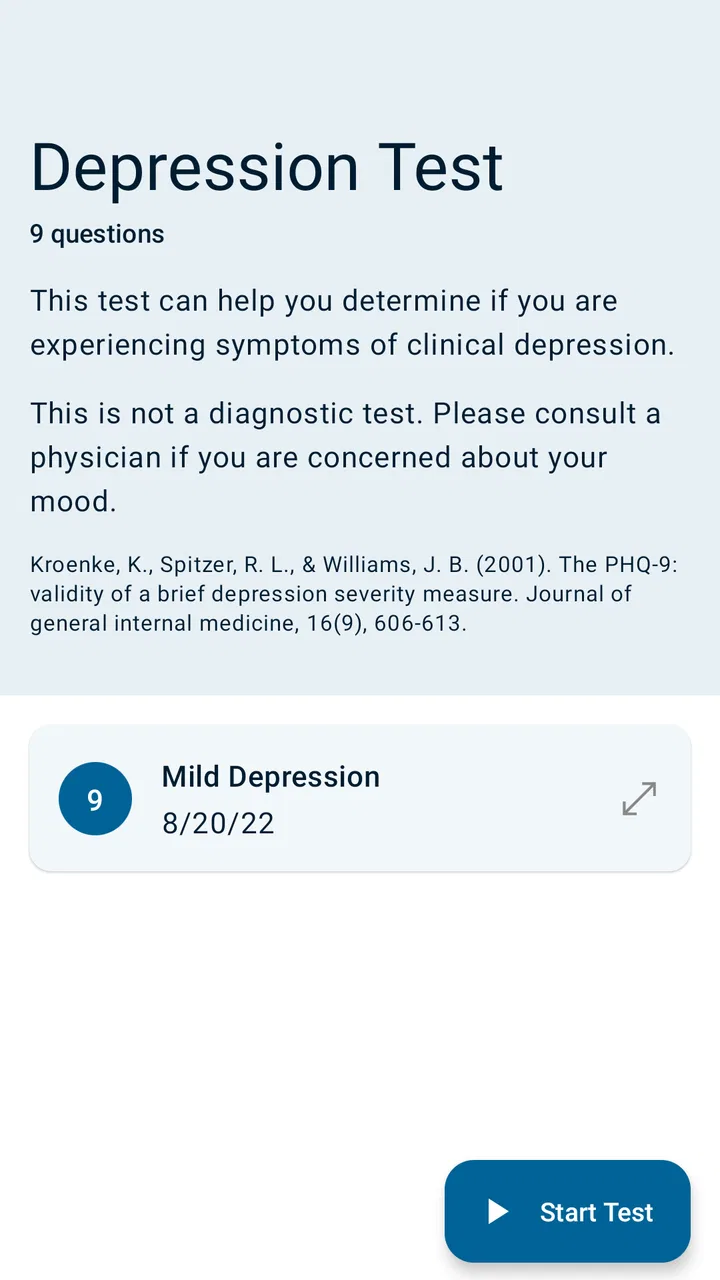
Depression Test
- 4.4
- Rating
- 500.00K
- Installs
- Free
- Price

 Analysis by App-foxy
I approached Depression Test as a quick self-check rather than as a replacement for a doctor, therapist, or emergency service. That distinction matters with a medical app built around a short set of questions: it can help me pause, name a concern, and decide what to do next, but it cannot explain the full story behind how I feel. In everyday use, I found its value is greatest when I treat the result as a conversation starter instead of a diagnosis.
This is a free medical app from Inquiry Health LLC, aimed at Everyone, and it has been available since Jul 24, 2014. Its focused purpose makes it easy to understand before installing: I open it, work through the depression-related screening, and use the outcome as a prompt for reflection. It is not trying to be a mood journal, a therapy platform, or a broad mental-health library. That narrow scope is both its main strength and its biggest limitation.
The app has an average rating of 3.8 from around 3.4K ratings, with 160 written reviews, and it has passed 500K installs. Those figures suggest that many people have found the format worth trying, but they do not tell me whether it will be suitable for a specific person’s situation. A screening tool can be useful even when it feels simple, while a polished interface cannot make a brief test clinically complete.
You May Also Like

 Blood Strike: 2.5 Anniversary
Blood Strike’s Loadouts Turn Every Drop Into a Tactical Gamble
A close look at Blood Strike’s custom loadouts: how fast access to signature weapons reshapes its battle royale rhythm, rewards preparation, and narrows the gap between fights.

 Pandora - Music & Podcasts
Pandora’s Music Is Easy to Start, but Harder to Recover
Pandora’s strength is its low-effort path from a seed to a station. Its weak spot is how much confidence it asks you to place in connection, setup, and quiet recovery.

 8 Ball Pool
 Is Built on Rivalries, Rematches, and Routine
A close look at the rivalries, rematches, shared routines, and unanswered safety questions that turn a quick pool match into a persistent mobile community.

 Samsung Music
’s Quiet Strength Is Playing What You Already Own
Its reach comes less from spectacle than from dependable access to a personal library. That simplicity is both the app’s strongest retention engine and its ceiling.

 AccuWeather: Weather Radar
AccuWeather Review: A Quick, Clear Forecast for Everyday Decisions
For everyday plans, the best forecast is the one you can understand quickly. AccuWeather makes rain timing, radar, and local conditions easy to act on, with a few trade-offs.

 Hill Climb Racing
Why Hill Climb Racing Still Turns Crashes Into One More Run
A tiny car, a bumpy hill and one more upgrade: Hill Climb Racing keeps resurfacing because its simple chaos makes every near-miss feel personal.
More From Our News Desk



What the short screening experience is actually good for
The central experience is built around nine simple questions. That makes Depression Test much less demanding than a full appointment or a long questionnaire. I can imagine using it when I have noticed a change in sleep, motivation, concentration, or general mood but have not yet organized those observations clearly enough to explain them to someone else.
A realistic example would be a difficult week at work or school. I might tell myself that I am merely tired, then notice that I am withdrawing from people and struggling to enjoy things I normally like. Completing the test gives me a structured pause. Instead of relying only on a vague feeling, I have a defined set of prompts to consider. The useful outcome is not a label; it is the decision to take those changes seriously.
The best way to use this app is as a first conversation with yourself, not as the final word about your mental health. I would write down what I was feeling before starting, answer based on my recent experience rather than an unusually good or bad hour, and then compare the result with how long the changes have lasted. That small routine reduces the temptation to treat one quick result as a complete assessment.
The compact format also makes it approachable for someone who would abandon a lengthy mental-health questionnaire. There is less preparation, less reading, and less pressure to understand clinical terminology. For a person who is unsure whether their concerns are “serious enough” to mention, that low barrier can be meaningful.
At the same time, nine questions cannot capture every factor that may affect mood. Grief, anxiety, burnout, physical illness, medication changes, substance use, relationship problems, and major life events can overlap with depression symptoms. A short result may point toward concern without showing which explanation deserves attention. I would therefore avoid using the app to reassure myself that everything is fine simply because the result feels mild.
A useful first step, but not a complete assessment
Compared with searching the web for a list of symptoms, this app offers a more contained experience. Search results can be overwhelming, contradictory, or written in language that encourages self-diagnosis. A short, purpose-built questionnaire is easier to finish and less likely to send me down several unrelated paths.
Compared with speaking to a qualified professional, however, the trade-off is obvious. A clinician can ask follow-up questions, notice context, discuss safety, and consider physical or psychological causes that a fixed sequence cannot explore. A therapist can also help me understand what to do after identifying a problem. Depression Test does not replace that human judgment.
Compared with mood-tracking apps, this is a different kind of tool. A journal can show patterns across days or weeks, while this app gives me a snapshot. If I want to see whether my mood changes with sleep, workload, social contact, or exercise, a tracker is likely the better choice. If I need a quick structured prompt before contacting a professional, this app is more direct.
Compared with crisis resources, it serves a completely different purpose. Someone in immediate danger, thinking about self-harm, or unable to stay safe should not spend time waiting for a screening result. The appropriate response is urgent help from local emergency services, a crisis line, or a trusted person who can stay involved. A test cannot provide the immediate protection that situation requires.
Trust begins with keeping the app’s role clear
Because this is a medical app, I pay attention to the difference between a screening experience and a clinical service. The developer is identified as Inquiry Health LLC, and the app is presented as a depression test rather than as a treatment system. That framing is important: it encourages me to judge the product by whether it helps me reflect clearly, not by whether it promises to solve depression.
I also prefer the straightforward category and age positioning. It is listed for Everyone, which makes the interface broadly approachable, but that should not be confused with universal suitability. A child, teenager, or adult may interpret mental-health questions differently, and younger users may need a parent, guardian, school counselor, doctor, or another trusted adult involved. The age label is a store classification, not personalized clinical guidance.
The app is free, which removes a financial barrier to trying the questionnaire. That is helpful for someone who wants an initial prompt without committing to a subscription. Still, free access should not be mistaken for a full care pathway. If the result raises concern, the next step may involve resources outside the app, including professional support that requires time, planning, or money.
Its current version is 2.0.4 and it requires Android 6.0 or later. That makes compatibility worth checking before installation, especially on an older phone. I would also review the app’s current store permissions and privacy information on my own device before entering sensitive answers. Those are sensible habits for any health-related app, and they are particularly important when the content concerns mood and depression.
What I would check before answering personal questions
When an app asks about mental health, I want to know what choices I have before I begin. I would look at the permission prompts rather than approving them automatically, read any available privacy explanation, and notice whether the app asks me to create an account. I would also consider who can see my phone, whether notifications might reveal that I used a depression test, and whether my device is protected with a passcode.
These checks are not a criticism of a specific permission or data practice. They are a practical way to keep control of sensitive information. Store pages and operating systems can show permissions and account settings, but I should still read the wording presented at installation and inside the app because those details govern my actual choices.
A particularly useful habit is to take the test in a private moment and avoid entering answers while someone else is looking over my shoulder. If I share a phone or use a family tablet, privacy becomes part of the decision to use the app. The emotional content of the questions may be personal even when the app itself is simple.
I would also avoid treating the result as something to share publicly or send casually in a group chat. If I want support, I can describe how I have been feeling and use the result as context, rather than forwarding a screenshot that may lack explanation. This protects my privacy and keeps the conversation focused on my actual experience.
How to turn a result into a sensible next step
The most useful workflow is to decide in advance what I will do with the outcome. If the result matches mild concerns, I might note the symptoms, tell someone I trust, improve my routine where possible, and arrange a professional conversation if the problem continues. If the result suggests more serious concern, I would not wait for repeated testing to validate my feelings. I would contact a doctor or mental-health professional and explain both the result and the symptoms behind it.
One non-obvious advantage of a short test is that it can help me prepare for an appointment. Before speaking with a clinician, I could record when the changes began, how they affect work or school, whether sleep and appetite have shifted, and whether I am withdrawing from normal activities. The questionnaire may help me notice topics to mention, but the notes provide the context that the app itself cannot supply.
I would not repeatedly take the test throughout the same day. Doing so could turn the experience into reassurance-seeking, where every change in mood creates a need for another score. A better approach is to answer thoughtfully, step away from the screen, and focus on persistent patterns rather than chasing a particular outcome.
Another practical tip is to answer according to what has genuinely been happening, not according to what I think a “depressed” person is supposed to say. Trying to produce a certain result undermines the purpose of the questionnaire. If I am uncertain about an answer, that uncertainty is itself worth mentioning to a professional rather than forcing a confident interpretation.
Parents and friends should be careful about using the app as an informal test for someone else. Asking another person to complete it can feel intrusive, and interpreting their result on their behalf can damage trust. A better use is to offer support, ask open questions, and encourage professional help when concerns are persistent or severe.
Where the experience may create friction
The simplicity that makes the app approachable also limits how much guidance I receive. A short questionnaire can identify a reason to pay attention, but it cannot explore the surrounding circumstances in depth. If I want explanations, coping exercises, therapy options, medication information, or a record of changes over time, I will need another resource.
There is also a risk of false confidence. A person may receive a result that does not seem alarming and conclude that professional help is unnecessary, even while struggling. The opposite can happen too: a concerning result may cause unnecessary fear if it is read as a diagnosis. I would interpret the output alongside duration, intensity, daily impact, and any safety concerns.
The app may also be a poor fit for someone who needs accessibility options, detailed educational content, or a guided care plan. The available store details establish its basic purpose and compatibility, but my own device experience and needs should determine whether the presentation is comfortable to use. If reading the questions, navigating the screens, or understanding the result is difficult, a professional or another resource is the better route.
People looking for ongoing accountability may also outgrow it quickly. A single screening session does not substitute for a journal, appointment schedule, therapy program, or support network. I would choose Depression Test for a narrow moment of uncertainty, not as the center of a long-term mental-health routine.
My cautious recommendation
I recommend Depression Test to someone who wants a brief, free starting point for thinking about possible depression symptoms and who understands the limits of a screening tool. Its nine-question format is approachable, and the focused design can help turn a vague concern into a more concrete decision to seek support. The app’s medical category and clear developer attribution also make its purpose easy to identify before use.
I would skip it as a primary solution if I needed treatment, detailed symptom tracking, crisis support, or a professional interpretation. I would also avoid relying on it for another person, using it to settle an urgent safety concern, or repeating it until I received a reassuring answer. In those situations, a doctor, therapist, crisis service, or trusted person offers something this app cannot.
For me, the right question is not whether the test can tell me definitively that I have depression. It cannot replace a proper assessment. The better question is whether it helps me notice a pattern and choose a responsible next step. Used with that expectation, it is a practical entry point. Used as a diagnosis, it becomes much less trustworthy.
Overall, I see this free app as a small but potentially useful check-in: easy to try, limited in depth, and most valuable when it leads beyond the screen. I would protect my privacy while using it, read the choices shown on my device, keep the result in context, and treat persistent or serious symptoms as a reason to seek qualified help rather than as something to measure again.
FAQs for Depression Test
01What is the purpose of the Depression Test app?
The Depression Test app is designed to help users assess their mental health by providing a quick and accessible way to evaluate symptoms of depression. It's not a diagnostic tool but offers insights into one's mental state, encouraging users to seek professional help if needed.
02Is the Depression Test app accurate and reliable?
While the app uses clinically validated questionnaires to assess symptoms of depression, its results should not replace professional diagnosis. It provides a general overview and encourages users to consult healthcare providers for a comprehensive evaluation and appropriate treatment.
03How user-friendly is the Depression Test app?
The app is designed with user-friendliness in mind, featuring an intuitive interface that guides users through the questionnaire with ease. It provides clear instructions and immediate feedback, making it accessible for people with varying levels of tech-savvy.
04Is my data safe with the Depression Test app?
The app prioritizes user privacy and employs encryption to protect personal information. It does not share data with third parties without explicit consent. Users can review the app's privacy policy to understand how their information is handled and stored.
05Are there any costs associated with the Depression Test app?
The basic features of the Depression Test app are usually free, allowing users to take the test and receive initial feedback. However, some advanced features or resources might require in-app purchases or a subscription, which are clearly indicated within the app.
Pros
- Easy to navigate interface.
- Quick and simple assessment.
- Provides immediate results.
- Non-intrusive and private.
- Free to download and use.
Cons
- Limited to basic depression screening.
- No personalized feedback offered.
- Requires internet for full features.
- Ads can be distracting.
- Lacks integration with healthcare apps.

Depression Test
Gallery